
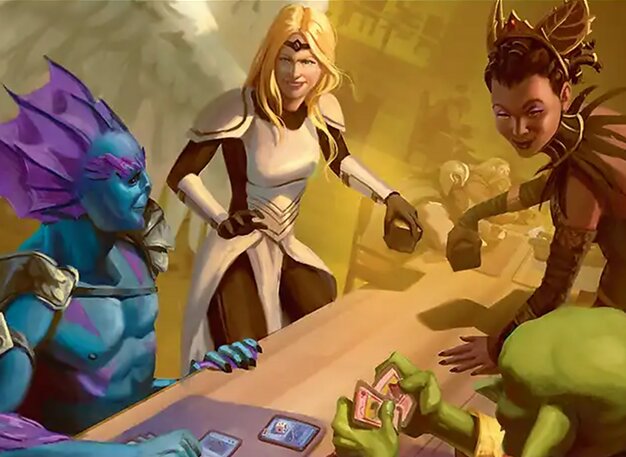

Fun game, not a good game?
I had an interesting exchange after a game recently.
We’d just finished a long, grindy match that ended in a draw. I said “gg, that was a fun game!” My opponent replied: “Yeah, I guess it was fun, but it wasn’t a good game.”
That response has stuck with me, because I think it reveals a fundamental tension in Commander about what we’re actually optimizing for.
Two Valid But Different Goals
In competitive Magic formats (Modern, Pioneer, Legacy, even competitive Commander) a “good game” typically means:
- Tight technical play
- Optimal sequencing and decision-making
- All players executing their gameplan at a high level
- Meaningful interaction and counterplay
- Games where skill expression primarily determines outcomes
This is completely valid. This is what makes competitive Magic compelling. The thrill of finding the correct line, of outplaying an opponent through superior technical execution: that’s real, and it matters.
But Commander, as designed, optimizes for something different:
- Memorable moments and stories
- Social interaction and table dynamics
- Creative deck expression
- Games where everyone gets to “do their thing”
- Experiences that are fun to talk about afterward
Neither of these is wrong. They’re just different games wearing the same rules.
The Fundamental Tension
Commander is unique because it tries to serve two completely different audiences with one rule set. Competitive players want consistency and skill expression. Casual players want variance and social experience. Both are valid. Both are Magic. But they’re not compatible at the same table without explicit alignment.
The Problem: Mismatched Expectations
Here’s where things break down: When you bring competitive optimization to a casual table, you’re not just “playing better.” You’re playing a different game entirely.
If three players sit down expecting a social experience where everyone gets to execute their deck’s gameplan and create fun moments, and one player is optimizing purely for win percentage and tight lines… nobody gets what they came for:
- The competitive player is frustrated by “suboptimal” play and lack of interaction
- The casual players feel steamrolled and never get their engines online
- The game ends quickly with one person satisfied and three people feeling like they didn’t really get to play
This isn’t about power level alone. It’s about intent.
You can have a high-power casual game where everyone’s running optimized lists and having a blast. You can have a low-power competitive game where people are grinding for every percentage point with precons. The issue is when the social contract isn’t aligned.
Rule 0 Is Not Optional
Rule 0 conversations are essential infrastructure for the format.
Before you shuffle up, you need to answer:
- What kind of experience are we trying to create?
- Are we optimizing for wins or for fun?
- What’s the acceptable power band?
- Are infinite combos, MLD, stax, fast mana on the table?
And critically: Are we all playing the same game?
The bracket system is useful, but it’s not enough that it exists. A “bracket 3” deck piloted with competitive intent is fundamentally different from the same deck piloted with “let’s see what happens” energy.
Rule 0 Is Self-Advocacy, Not Politeness
Let’s talk about the reality of LGS Commander nights.
You walk in. There are three other people at a table. Maybe you know them, maybe you don’t. Someone says “need a fourth?” You sit down. Everyone starts shuffling.
This is the moment.
And most people… good, conflict-averse people… just shuffle up and hope for the best. Because asking questions feels awkward. Because you don’t want to be “that guy” who slows things down. Because everyone else seems ready to play and you don’t want to be difficult.
So you say nothing. And then fifteen minutes later you’re watching someone combo off on turn 4 while you’re still playing your third land, or you’re getting stax-locked out of the game, or you’re the only person at the table who isn’t running tutors and fast mana.
And now you’re having a bad time. But you can’t really complain, because nobody lied to you. You just didn’t ask.
This is the “just shuffle up” trap.
Nobody’s Curating Your Experience
The truth about playing Commander at your local game store is that you are responsible for your own fun. There’s no matchmaking algorithm, no shared Discord where everyone’s deck lists are posted, no store staff managing power levels. If you don’t advocate for the experience you want, you get the chaos default. Power levels range from precon to cEDH-adjacent. Expectations about interaction and combos vary wildly. Someone’s ‘casual deck’ with Mana Crypt and Gaea’s Cradle sits next to someone’s unmodified precon. And then afterwards, someone’s going to be salty. All of this was preventable.
Permission to Ask Questions
You need to advocate for yourself before the game starts. Not because you’re being demanding, but because you’re preventing a bad experience for everyone. None of these questions are about control. They’re about alignment.
Here’s your permission structure. These questions are not rude:
“What power level are we playing?” Not just bracket numbers, actual conversation. “I’ve got a tuned deck with some fast mana” or “This is a precon with upgrades” or “I’m testing a jank combo, it probably won’t work.”
“Are infinites on the table?” Some people love them. Some people hate them. Find out now, not after someone goes infinite on turn 5.
“How do we feel about stax/MLD/heavy control?” These strategies are legal, but they’re also miserable if the table isn’t expecting them. Get alignment.
“Is anyone trying out a new deck?” This is code for “should we maybe not play our most optimized stuff so everyone gets to see their deck work?”
“What are we optimizing for: wins or fun?” This is the real question. Some nights you want to battle. Some nights you want to see cool interactions. Be explicit.
Language That Works
If you’re worried about sounding like you’re being difficult, here are some phrases that work:
“Hey, before we start, what are we playing? I’ve got a few decks at different power levels.”
- Positions you as flexible and thoughtful
- Invites others to share their expectations
- Doesn’t presume anything about the table
“Fair warning: this deck can go infinite with [X] + [Y]. Should I swap to something more casual?”
- You’re not apologizing, you’re informing
- Gives the table a chance to opt in or out
- Shows you care about the experience
“I’m looking for a pretty casual game tonight. Does that work for everyone?”
- Direct but friendly
- Lets people adjust their deck choice
- Sets expectations clearly
“This is my first time playing this deck, so I’m probably going to durdle. Just FYI.”
- Manages expectations
- Signals you’re not trying to pubstomp
- Invites patience from the table
When Someone Else Isn’t Advocating
Here’s the harder scenario: You ask these questions, and someone says “yeah yeah, it’s casual” and then proceeds to pop off with a tuned combo deck.
This is frustrating. But it’s also information. Maybe they genuinely think their deck is casual. Maybe their playgroup has different standards. Maybe they’re being disingenuous. It doesn’t matter much in the moment.
After the game, you can say: “Hey, that felt pretty high-power to me. For next game, I’m going to bring something more optimized to match.”
And then you do. Or you don’t pod with them again. That’s also valid. Not every pod is worth fixing, and choosing not to play with someone isn’t a failure, it’s boundary-setting.
The point is: you tried. You advocated for your experience. They misrepresented theirs, whether intentionally or not. Now you have data and can make informed choices.
The Social Contract
The days of assumed shared context in Commander are over. The format’s too popular, too diverse, too fractured across power levels and playstyles.
Rule 0 isn’t about politeness or tradition. It’s about explicitly negotiating the social contract before you shuffle up.
If you don’t do this, you’re gambling. Maybe it works out. Maybe it doesn’t.
But if you advocate for yourself, if you ask the questions, name your expectations, and give others space to do the same, you dramatically increase the odds that everyone walks away from the table wanting to play again.
And that’s how you build a healthy Commander community.
Fun Is Not Optional
Here’s my thesis: In casual Commander, if everyone had fun, it was a good game. Full stop.
Did you make a mistake? Did you miss a trigger? Did you lose? None of that disqualifies it from being a good game if you enjoyed the experience.
Conversely: Did you execute perfect lines? Did you win on turn 5 through optimal play? If everyone else was miserable, it wasn’t a good game, regardless of how technically impressive it was.
In casual Commander, “everyone had fun” is the only metric that matters. Technical perfection without buy-in from the table isn’t impressive. It’s just pubstomping. Competition and optimization are great when everyone opts in. Without consent, you’re just being that guy.
This doesn’t mean every game has to be group hug chaos where nobody tries to win. Competition and optimization are fun! The key is that everyone at the table is opting into that experience.
The Social Game
Commander is, at its core, a social format. The technical game of Magic is just the framework. The real game is managing table politics, reading social dynamics, creating memorable experiences, and ensuring everyone walks away wanting to play again.
You can be the best technical player at the table and still be bad at Commander if you’re not considering the social experience you’re creating.
Likewise, you can make suboptimal plays, lose repeatedly, and still be exactly the person everyone wants in their pod if you’re making the game more fun for everyone.
Final Thoughts
So what makes a good game of Commander?
For me, it’s when everyone gets to execute their deck’s gameplan at least once. When there are interesting decisions and meaningful interaction. When someone does something that makes the table laugh or lean forward or say “wait, you can DO that?”
When we shuffle up for game two because that was so fun we want to do it again.
The wins and losses? Those fade. The stories stick around.
My opponent said that fun game wasn’t a good game. But I think he had it backwards. In Commander, fun is what makes a game good. Everything else is just details.
What does a “good game” mean to you? How do you navigate Rule 0 conversations at your LGS? I’d love to hear how different communities handle this. Drop a comment or reach out through the contact page.

Start the conversation